Introduction
This piece was written for the Secular Buddhist Network’s (SBN) website, in partial response to Ken Leong’s “Reconstructing the Dharma” in which he proposes reconstructing our understanding of what the Buddha saw through “axiomatic reasoning” — with one of the axioms being of anattā, which he there calls “non-self” though over on Facebook he quite often defines it as “no-self”. Since I am convinced the Buddha avoided dogmatically denying that there is any self of any kind, he and I debated the definition at some length, debates which inspired the insight presented here.
I had hoped to write often for the SBN, but since they rejected this piece as too theoretical, and not having visible relevance to secular Buddhism — and out there in the “theoretical weeds” is where I live and pretty much all I write about — I guess not.
At any rate, I find the connection made in this piece to be logically consistent with my understanding of what the Buddha was doing with not just dependent arising, but throughout his teachings, I don’t want the piece to be lost, so here it is.
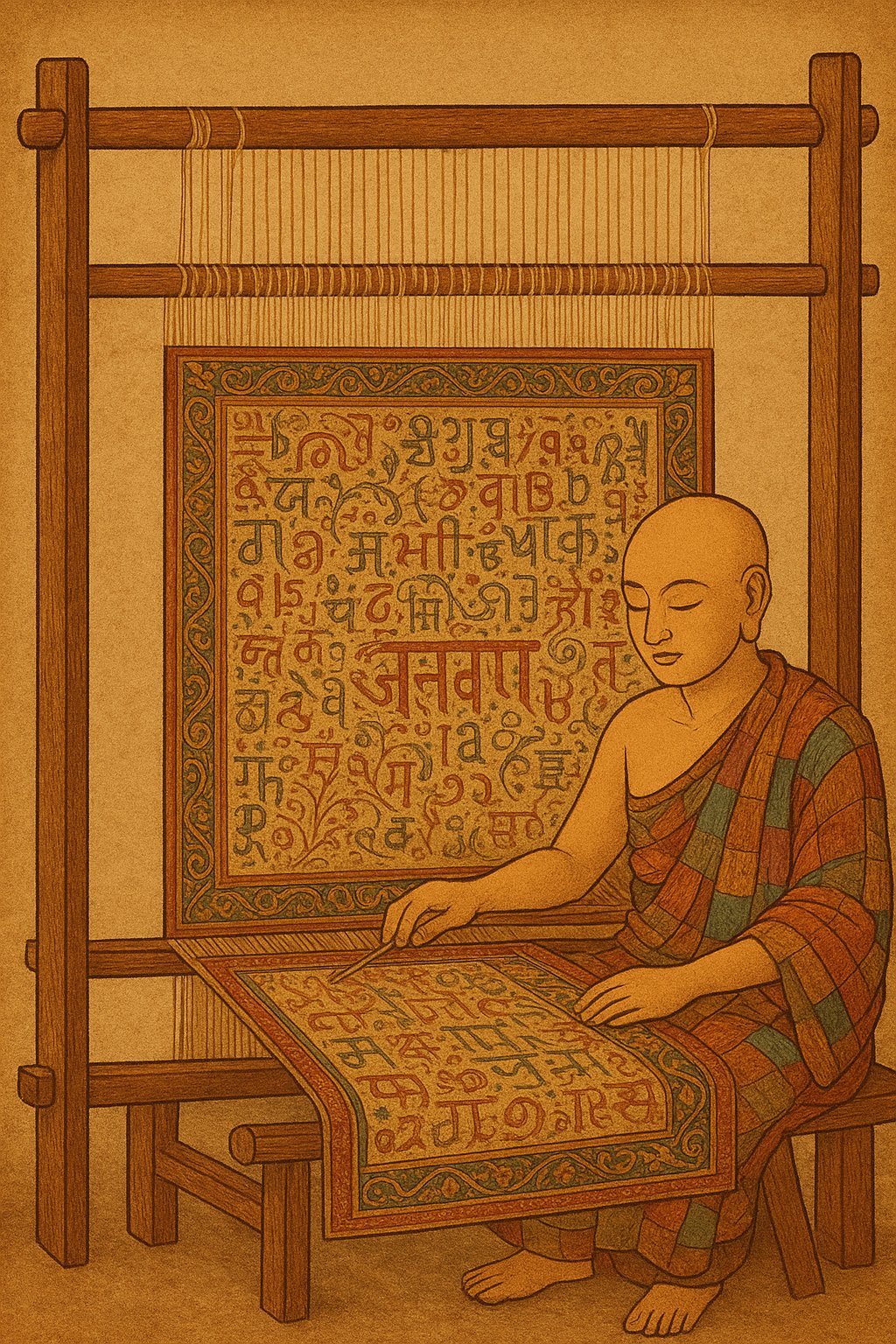
The Buddha’s Tapestry
The Buddha’s many talks are a carefully woven tapestry made of deeply-considered, thoroughly interwoven threads of meaning. Anattā as “not-self” fits the whole of the Buddha’s teachings, but when translated as “no-self” it’s a thread pulled up, ready to spoil the beauty of the whole.
This post may seem like a description of an entirely dry, academic discussion between nerdish types, but there’s another level to the debate about the meaning of anattā, that hasn’t been paid attention to for centuries, for millennia, and that’s the pure artistry that went into the creation of the Buddha’s lessons.
Professor Joanna Jurewicz’s year 2000 paper, “Playing With Fire” gave the Buddhist world a critical key to understanding not just what the Buddha was trying to get across to us with Dependent Arising (DA) but how he created the lesson he did. Not a Buddhist herself, she may not have been accurate in all her guesses at what he was doing, but she was spot-on with many, and gave us enough information to see what he was doing, if we are willing to have a fresh look, and loosen our grip on traditional interpretations.
But I’m not here to talk, this time, about the technicalities of possible new understanding of DA, but of beauty.
As I’ve worked, over the past decade and more, on trying to see how exactly the Buddha used the references Jurewicz pointed out, I came to notice several things, primary among them the extreme care he used in constructing his teachings, and the subtle way he made reference to the mythos Jurewicz pointed out, using the way it applied to daily life in his culture. He subtly addressed the philosophical arguments built on it, used its literary history and language, as well as, himself, using the methods of the philosophers and teachers who passed it on, with a unique, amusing and skillful modification.
The insights the Buddha was trying to get across were so new that there was as yet no language he could use to explain them. As Jurewicz explains it in her books, the method the ancient Vedic poets had used to convey their obscure new ideas about the creation of the ātman and its connection to a universal force — Brahman, “the All” — was to speak of everyday situations, familiar to all, that paralleled the points they were trying to make: in other words, using the mundane to call to mind the obscure. The Buddha gave that style of teaching a significant twist, using that same creation story and the mythos built around it to call to mind the very mundane new concept he was trying to describe, though there was as yet no language to express it. In other words, he used the story that had once conveyed new and obscure ideas about the ātman and rebirth, to try to get people to understand human psychology: using the obscure to explain the mundane.
That was such an elegant method, expressive (as I see it) of the artistry of a brilliant mind like no other in our knowledge of history.
It saddens me that the depth of the Buddha’s skill has gone unnoticed for so long. Oh, we talk about his “skill in means” but that’s just like the way his Dharma is effective in the beginning, middle, and end. When very well understood it is so powerful, that even when we are just beginning to put his teachings into practice, we see results, which keeps us digging in. The same is true of his skill in means: we see it, but I would suggest that what we are seeing is only the faint traces of it. When we see how integral his method is to what he teaches, and how deep it goes, how thoroughly embedded in his time while at the same time aiming to convey enough that is ageless so it will survive the changing nature of human culture, it’s truly astounding.
An Example Of What We Miss
A recent exchange with Ken Leong over on Facebook’s Secular Buddhist Group is what brought this back into mind. He and I generally agree that the Buddha was not trying to convey rebirth as a cosmic justice system that is key to accept, and that the point of his teaching was not “how to escape” from a literal cycle of rebirth. Even with that agreement, we do debate many other of the finer points of what the Buddha was saying. In this case, in a post about misunderstanding the discussions of rebirth in the suttas, the translation of anattā and its meaning came up.
I appreciated a line of his in which he suggested that what anattā represents is a relinquishment of belief in a lasting self, and I said so in a comment. I went on to suggest that, in his post about the Buddhist sphere’s misunderstanding of rebirth, he leaves out a supporting point: the Buddha’s emphasis on refraining from holding views. If I have no experience of rebirth, believing in it is holding a speculative view. “This is how I know that he wasn’t telling us all that belief in rebirth is necessary,” I said in my comment.
Part of Ken’s argument, though, was that if there is no self, there is nothing to be reborn. Because I’m sure the Buddha was not intending anattā to be a dogmatic statement about something we cannot know from direct experience, I objected. In writing up my reasoning, I came to realize — once again — that there was a lovely reflection of the language and philosophy of the Vedic poets expressed in the Buddha’s use of anattā as “not self”.
First, a little context. What Jurewicz’s clues revealed is that the Buddha used the Vedic myth of creation — of everything, but especially of the ātman within each of us — as a parallel to something once obscure, to express something mundane: the way we create what was mistaken for the ātman, what we now mistake for a lasting self. The parallel between the myth and its uses in Vedic rituals is extremely close to what the Buddha is saying about how we create a sense of self, making it a useful teaching tool for those of his audience who saw that parallel.
With his use of the word anattā — an- meaning “not” and the attā in Sanskrit is “ātman” — the Buddha is pointing to the method he offers us to discover that what we think is self/ātman, is not lasting. He asks us to give a close examination to every way we define a self as lasting and notice that it arose out of conditions, and continues as long as conditions remain, and then fades away: not lasting. When conditions change — let’s say we suddenly realize kicking the dog was mean and unnecessary — that aspect of us (as “someone who kicks dogs”) changes. Basically, the Buddha asks us to notice that everything we point to as who we are, as “self” is “not self” so is “not ātman” — not lasting, not separate from the events in the world, but is constructed.
That use of the word anattā to point to the strategy we have for noticing that what we think of as self reveals that it is not self, along with the fact that we have no direct experience that can prove there is not a self out there that is permanent and lasting but has no visible effect in our lives, well, those two alone make it clear that the Buddha’s intended meaning of anattā was not a denial of there being any self, but just that we have no evidence for a lasting self.
But anattā as not self has more significance than that.
Just as the shape of dependent arising uses the shape of the Vedic myth of creation to make its points — reflecting ancient philosophical teachings, but expressing that their understanding was off — so too anattā as not-self does the same.
In the BrU, within many discussions of what ātman is, is a famous phrase: “Neti. Neti.”
Ātman is “Not that. Not that.” Yajnavalkya says that ātman cannot be described by any known means — it is beyond all description — so whatever you ask “Is it this?” he will have to answer that it’s “Not that.”
The Buddha is using a famous predecessors famed language to say almost the same thing. Whatever we believe that lasting self to be, it’s not that. Yajnavalkya meant “It exists but is inexpressible” while the Buddha was saying, “Can’t see that it’s lasting? Then it actually is not anything but speculation.”
Perhaps it’s just me, but I find the elegance of the connection of the Buddha’s use of anattā to simultaneously reflect and refute the very definition (or lack of definition) of ātman to be just stunning.
This is just one small example of how what he did in constructing dependent arising gets reflected throughout the talks he left us. There is incredible, as yet unseen beauty in the way he put his lessons together, with that thread of commentary on the belief systems of his time, using the way they were expressed to make his own point, all throughout the suttas. It only needs some effort from those of us who love the teachings and have both the time and some interest in digging into the suttas with an open mind to find more and more of these. And I hope, over the course of years during which Secular Buddhism develops, we take that time.
Excellent as usual! I particularly like your “carefully woven tapestry” idea; It has been something I’ve found helpful since I first heard you mention it some time ago. I’ll only add this for now– our difficulty appreciating the weave may have to do with oral transmission. A sutta is perhaps often not a full record of a discourse, but key notions that serve as an aide memoire so what may superficially seem only weakly related notions strung together are actually intended to recall a more connected progression of ideas which would be recognised by listeners ‘in the know. And I can see how, if the warp and woof aren’t appreciated, the disjointed ides might seem like axiomatic statements.
Linda, do you know The Great Full-Moon Night Discourse
Mahā Puṇṇama Sutta (MN 109)? discusses not this, not this in relation to self & aggregates
Hi Michael. Wonderful to hear from you. I agree that the nature of oral transmission probably made it difficult to recognize the Buddha’s weaving of his ideas together, and the way what he’s saying is in intimate interaction with Vedic philosophy and teachings. Also, it seems to me that all too quickly, the suttas got seen as a sort of separate universe of revealed truth, so there was no concept of studying the Vedas to look for links in the Buddha’s talks back to what they were saying. Heck, only recently have we begun to understand the complexity of the Upanishads and Brahmanas and the Vedas themselves.
Plus it’s my perception that the Buddha, in his efforts to support belief in rebirth and push it toward a system more concerned with morality than with self, was intentionally being a bit cryptic. Which worked in the intended goal but didn’t help the clarity of his message any.
I pulled up my Kindle version of the Middle Length Discourses and find lots of highlighted passages, including him speaking of each of the aggregates as “This is not mine, this I am not, this is not myself.” Does seem like he’s tapping on Neti Neti, doesn’t it, and many in his audiences would have recognized what he was doing. At the same time he’s just being clear about what he teaches! so it’s understandable that the connection got lost.
I’m fondest of his mind-reading in that sutta, imagining there’s someone there thinking if none of the aggregates are self, the pattern being each of them are “not-self” then there is a not-self to do bad deeds, so what self bears the brunt of those actions? It’s a question many still ask today!
And makes me wince since I say there *is* a not-self. (Mark Knickelbine used to scold me about that usage, because the Buddha would never have said it.)
Anyway, thanks again for dropping in to read the piece and comment. Always fun to chat with you.